
Untamed Authority: The Magnetism of Apex Predators
There is a quiet, unmistakable affinity between formidable individuals, gifted minds, and apex predators. Whether observing a wild cat, a cobra, or a falcon, those who operate at the highest echelons of power, creative vision, or societal influence are frequently drawn to these creatures. It is not a matter of superficial novelty, but a simple deep psychological recognition: power recognises power. Apex predators embody a rare convergence of mystery, beauty, and absolute presence. To understand why figures across history, from ancient dynasties and Eastern royalty to visionary executives and public figures, are fascinated by wild beasts is to understand the subconscious mechanics of power itself.
When an individual steps into high visibility or institutional authority, their internal landscape undergoes severe demands. In this environment, the wild animal becomes a mirror for non-verbal mastery and instinct. For those in the public eye or in positions of immense influence, few skills are more vital than the capacity to set unshakeable boundaries and instantly detect covert manipulation. Apex predators possess an extraordinary, natural ability to do both, continuously reading micro-shifts in their environment to identify hidden motives long before a threat materialises. An apex predator operates from a baseline of complete sensory awareness, inhabiting its authority rather than performing it. It establishes non-negotiable boundaries without dramatic displays, commanding a respect that is quiet, immediate, and non-verbal. To misread its boundary is fatal, offering high-stakes leaders a profound subconscious model of sovereign composure and an instinctual advantage.
Furthermore, a big cat or raptor rarely wastes movement. It moves slowly, observes deeply, and acts with singular, decisive precision only when necessary. This reflects the archetype of the visionary leader who stays one step ahead, operating from intuition rather than panic, and conserving vital energy for moments of critical execution. The magnetic draw of a cobra or tiger lies in this tension, where serenity masks immense capability. For public figures whose day-to-day existence requires maintaining an unflappable presence under intense public projection, the predator represents an unshakeable internal sanctuary.
This psychological link is why humanity has long entrusted apex beasts with the protection of its most sacred thresholds. Across ancient traditions and real-world history, wild animals were depicted as the ultimate sentinels of secret vaults, precious stones, and esoteric knowledge. From mythical dragons guarding temple entrances against the uninitiated, to the legendary cobras carved into the subterranean doors of Vault B at the Padmanabhaswamy Temple in India. This temple houses an immense collection of gold, pearls, and diamonds estimated to exceed one trillion dollars in antique value, and the serpent symbolises a boundary that cannot be coerced, bought, or persuaded.
In Eastern esoteric traditions, the Nāgas, serpentine guardians of subterranean realms, were not merely protectors of physical gold and jewels, but custodians of profound psychological treasure: secret teachings, higher states of consciousness, and the esoteric mastery of supranormal faculties and intuitive power. Ancient lore even speaks of the Nāgamani, the mythical jewel encased within the crown of the serpent's head, said to emit an ethereal light in total darkness and bestow unmatched power upon its bearer. This jewel is the ultimate symbol of enlightened intellect and untamed instinct combined: a luminous consciousness forged within the depths of raw, lethal power. To place a serpent as a custodian of value is an explicit statement: true power, whether spiritual clarity, self-mastery, or material wealth, is protected by an unyielding instinctual force that strikes without hesitation when unearned entry is sought.
In private clinical practice, the presence of raw, untamed nature often acts as a potent catalyst for self-regulation and personal sovereignty. In my earlier career as a lead actress, I experienced this directly while playing the lead role of Aki in AO: The Last Neanderthal, a character defined by an unyielding, wild, and powerful force. To anchor that primitive authority before stepping onto set, I surrounded my makeup mirror with images of the eyes of a wolf. Staring into those eyes became a daily ritual of psychological alignment, tapping directly into the feral focus and unbroken awareness required for the role.
Later, during my years operating a private practice secluded in the Hollywood Hills, I observed this same phenomenon with clients. In the main sanctuary, I introduced an elaborate vivarium housing a rare arboreal Blue Beauty snake (Orthriophis taeniurus callicyanous), a species known for its stunning beauty, remarkable vigilance, and feisty, confident nature. His name was Vayu, translating to the God of Air, as he moved with effortless fluidity and preferred perching high above the room. Clients naturally sought interaction with him, and he often sunned himself in the secluded private garden.
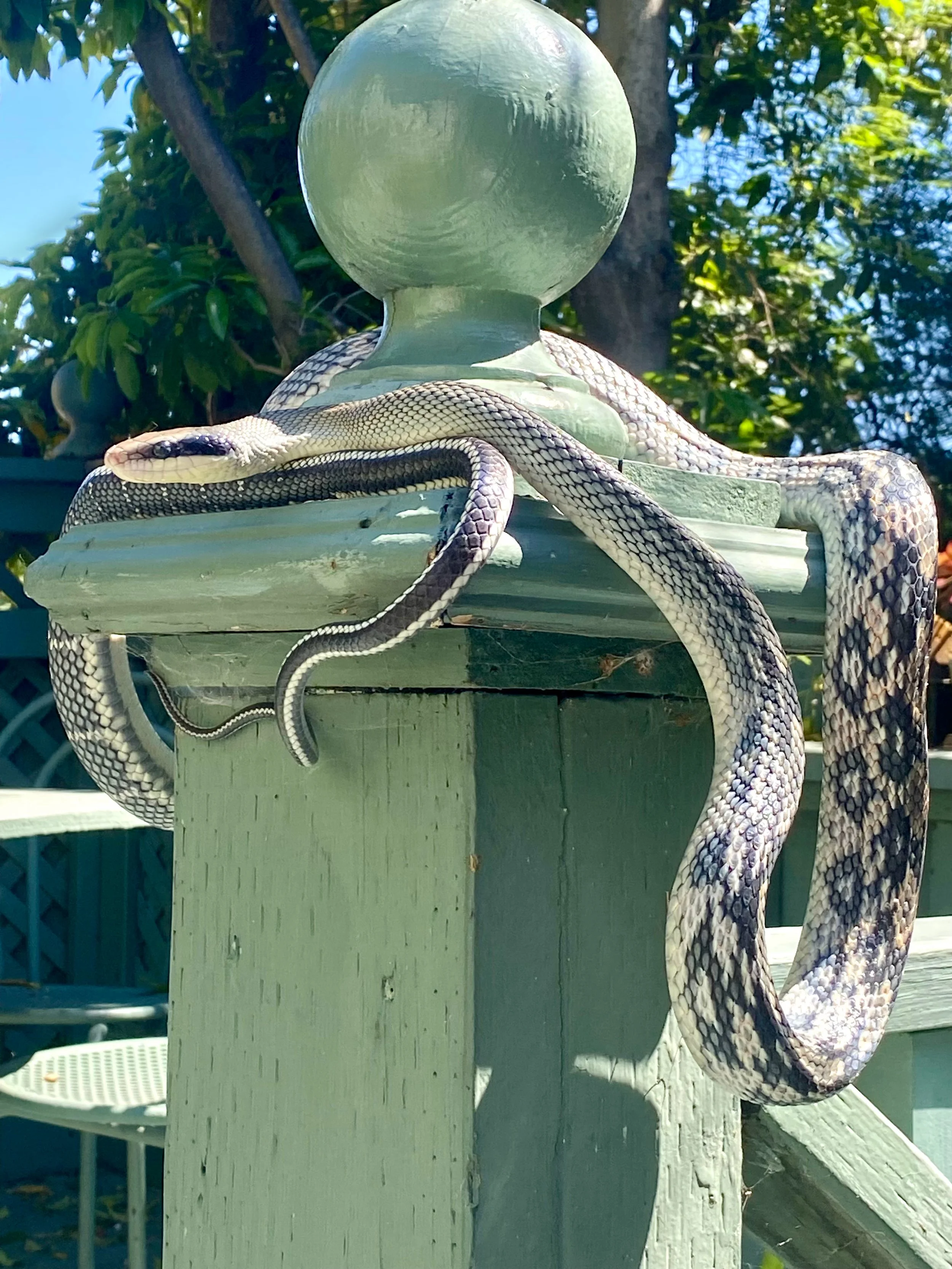
The clinical response from high-caliber clients was unanimous. Rather than fear, there was an immediate, grounding awe. The presence of a creature that exists in absolute present-state awareness forced a sudden drop in cognitive noise. Clients instinctively aligned their own energy to match the quiet, composed state required around a wild entity, with one client so profoundly affected that they immediately acquired a Madagascan Dumeril's Boa, a species with no natural predators in the wild, to cultivate that same unshakeable presence within their daily life. When an individual feels vulnerable or exposed to external turmoil, connecting with the elemental archetype of the predator bypasses intellectual defence mechanisms, tapping directly into the primal part of the psyche that overcomes fear and reclaims authority.
The desire to keep, surround oneself with, or wear the likeness of wild beasts is ancient and continuous. From the historic top-floor exotic pet sanctuary at Harrods that used to supply tigers to international royalty, to modern cinematic representations of old-money estates with wild animals, the apex predator remains the ultimate symbol of untamed sovereignty. Even in personal adornment, from high-fashion snake prints to draped faux fur coats, society continuously seeks to wrap itself in the visual language and instinctual strength these creatures signify. The psychological attraction is not about possession in the trivial sense, but about proximity to a presence that remains uncolonised by societal expectation. For the formidable individual navigating relentless external demand, the apex predator serves as a reminder of what exists beneath the public mask: an innate, quiet capacity to hold ground, set boundaries, and move through the world with absolute clarity.
Aruna Shields
Therapy & Advisory for Public Figures, Leaders & Gifted Individuals
For private enquiries and consultations, visit Bookings